In Search of the Truth
“…the truth will set you free.”
“What is Truth?” Most famously said by Pontius Pilate during Christ’s official questioning at his trial on the day of the cross. The Roman governor was responding to Jesus’ declaration, “…Everyone who is of the truth listens to my voice.”
While most Christians will likely roll their eyes at Pilate’s rhetorical question, it is a very real and poignant question today, perhaps especially amongst Christians. We are in a current struggle about what is true concerning Christianity, concerning what’s going on in the world, and expressly in an era fraught with mass amounts of conflicting information, facts, and data from government and education institutional sources, large media conglomerates and even down to homegrown reporting sources. These days we’re in a battle for plain facts, not to mention what is true. Additionally, we are in a context where some Christians weaponize biblical facts and disguise their destructive payloads as “the Truth.” So how can we get to authentic, life giving and freeing truth?
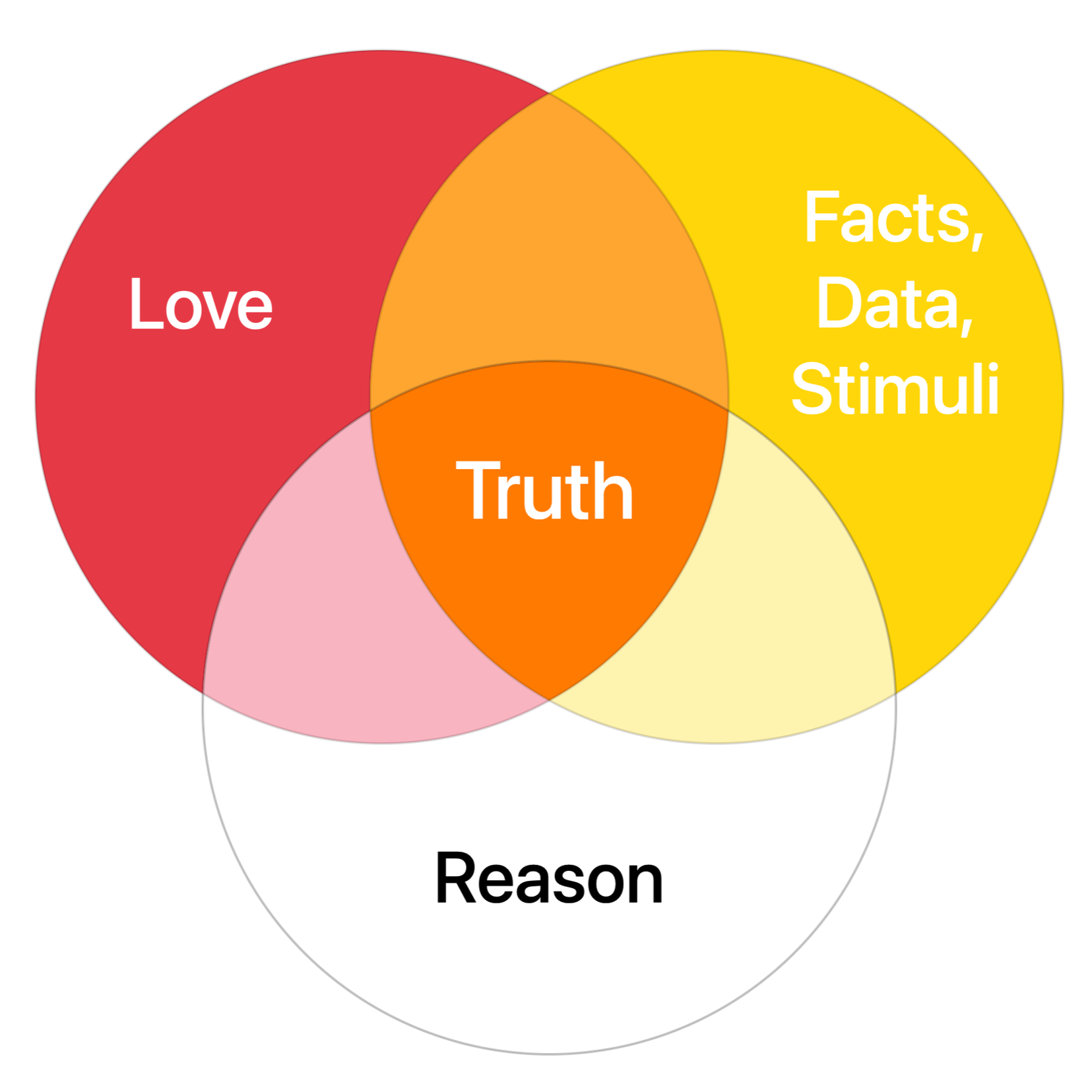
What if the Truth, authentic and deep Truth, is the most loving and reasonable interpretation of the facts in a context? And, what if when we don’t use love and reason as the means to interpret facts regarding a situation, that we are actually not engaging in Truth? Or worse, what if by using our biases, visceral reactions or fear based responses to interpret the facts we are actually telling lies?
First I’d like to make a distinction between “truth” and “facts.” Secondly, I will explore what it means to interpret facts, specifically facts in the scriptures and where interpretation starts. And we look at Jesus’ interpretation of the Scriptures compared and contrasted to His contemporaries. Thirdly, I want to address our use of the facts and truth as applied in Christendom and in the world at large. Finally, what impact I believe this has on us.
Truth vs Facts
Often we use the words “fact” and “truth” interchangeably. And, of course, you can. But in the context of relating information from a particular perspective I like to make a distinction between the two words. I define “facts” as bits of raw data or stimuli that are true but given no interpretation. Whereas, I think of the “truth” as “facts” that have been filtered through a point of view to relate something that is greater or more impactful than a set of data points.
Humans don’t actually act on raw data. Sets of information are of no use until someone applies a perspective. It’s when you look to apply the data to a situation that the data becomes meaningful. This is similar to the ideas of potential energy versus kinetic energy: The potential energy is there but until it is applied (kinetic) it is not felt or understood. Moreover, energy is just energy. It isn’t good or bad. How we put that energy to use can be destructive or creative.
In the same way, facts, data, information and stimuli lie dormant until they are arranged and applied to a specific context. For example: I have four apples, is a fact. But what is the Truth about that? Who cares without context? What meaning does that have without a story? What other facts exist to help us understand why having four apples is important?
No doubt you’ve heard people say something like, “The facts speak for themselves,” or “The data suggests…” The problem here is that facts don’t have a voice and data can’t suggest anything on its own. The facts simply exist as if in a vacuum until they are chosen and put to use. Someone must voice them. A person must arrange them, interpret them and apply them. When they are voiced, which facts, data, information or stimuli are chosen and in what order already provide one level of interpretation. When and where they are spoken provides another level of interpretation, even if they mean only to convey the facts and don’t mean yet to apply them. These sets of data put before the other humans are meant typically to become the boundaries of whatever discussion, problem, or story given.
On interpreting Scripture
Unilaterally Christians believe the Scripture contains Truth. And we believe it is true, reliable and indefatigable. Even so, it still requires us to interpret them. Indeed, we interpret the scriptures for good or ill simply by engaging them. And if Jesus is “The Truth” then the scripture does not contain all of the Truth. God’s word as we know it does not contain all of the aspects or reality of Christ Himself. They are a static code that is meant to be thought through, reasoned with, discussed and applied. In fact, all of Jesus’ discussions revolved around interpreting the scriptures, primarily the Law and Prophets, in the truest way.
Reading scripture is an act of interpretation even if you were to read it in its original language or, to push the point further, even if you read the scriptures in its original script. How is reading the scripture an interpretation of the scripture? Because as we read we have a voice we apply to the words. Some words stick out over others. We emphasize different words and phrases in our mind, translating their meaning based on our culture, upbringing, experiences and attitudes. Hearing the scriptures read aloud by someone else is another layer of interpretation. You will hear the same words as the person sat right next to you and yet may experience them in a completely different way.
Another layer of interpretation is any work of translation, no matter how faithfully and prayerfully prepared. The best translators must still make choices about what words from Hebrew or Greek might communicate most effectively their meaning in our modern language. This is especially apparent in translations of Hebrew poetry. This is why you may have wildly different yet faithful translations of different lines in the Psalms. Most of them render something true, but often fall short of the whole meaning. My point here isn’t that we all need to learn Hebrew and Greek, but rather that we understand interpretation must be employed in order to translate anything, even the scriptures.
One of the wisest things that Israel ever did was institute the synagogue system. This was not a requirement in the Law nor was it suggested by a prophet. Yet Israel instituted a specific place and time to regularly read God’s instructions in the context of community in order that all of Israel may participate in lively discussions about what it means to live those instructions. This was done after returning from their deportation to Babylon. Nehemiah eight sets the scene as the people gathered to hear Ezra read aloud the words of God from the Law (the first five books of our bible) after the walls of Jerusalem are rebuilt. There were levites among them in the crowd that help interpret the words that were spoken from the Law to make it more sensible and actionable. Jewish tradition says that Ezra organized a reading list from the Law broken up into portions so that the Law would be read on every sabbath in every synagogue of the Jews. This would see that all Israel would read from the same portion regardless of what city or village they may be in as it is to this very day. The purpose? So they could do what was written in it.
Even so, by the time Jesus arrives on the scene, Israel is occupied yet again and moving far away from God’s intent written in the Law. The understanding, the interpretation of the text by the majority leaders, was crippled resulting in a worldly way of applying God’s amazing instructions. This made Israel one more voice in the throng of power brokers vying for political control and subjugation instead of advancing a kingdom of freedom.
There were several different religious groups amongst the faithful during the Roman occupation of Israel. Most notable historically and mentioned in the gospels are Pharisees, Sadducees, Zealots, Essenes and disciples of John the Baptist. All of these groups had different interpretations and applications of the very same Law.
Our use of the Truth: The Truth will make you free
Jesus is there in their midst to teach the way of God accurately, amongst other reasons. To instruct, guide and lead people to the truest form of God’s intention for this world. To actualize the Kingdom of God through discussion and story. To plant ideas that set people free from a world system bent on their slavery.
During Jesus time as a rabbi one of the big questions the religious crowd was trying to work out was: What is the greatest commandment? (There is much more to say about this but for the sake of focus, I will not go into it here.) There were great discussions about what the foremost commandment should be amongst the six hundred and thirteen instructions that were in the Law. Jesus actually picks a side on the discussion and agrees with the majority interpretation that the greatest commandment was indeed that “You shall love the Lord your God with all your heart, with all your mind and all your strength.” Even in that camp there was a disagreement on what the second most important instruction was. Jesus again picks a side, “A second is like it, you shall love your neighbor as yourself.”
And even still inside this camp there is disagreement on what it looks like to love your neighbor. As one lawyer put it to Jesus, “Who is my neighbor?” The lawyer in the lead up to one of the most famous parables told by Christ has all the facts, even his initial interpretations are correct and still we must drill down passed those facts to the heart of compassion that is required by all truth telling.
As Christians we take these statements for granted without realizing all of the years of discussions, arguments and faithful study with prayers that went into this epic understanding.
As we read the words of Jesus in the Gospels and we read the words in the letters of the Apostles we see that there are facts that are laid down, but the Truth appears to emerge from an interpretation that is founded from love. That is, a love of God which according to Jesus means a love of our neighbor. Knowing the scriptures, that is reading, meditating, discussing, praying and experimenting with them, is meant to be a given for every believer. Without knowing them how can we test ideas, plans and actions. But understanding them in the context of God’s love for humans seems to be the crucial component in speaking and experiencing the Truth. If we filter the scriptures through something other than love we will end in condemning others or even ourselves. We might actually be producing lies which lead to slavery and destruction instead of a truth that fosters freedom and life.
But Jesus left us. After forty days of resurrected life on earth, he ascended to the right hand of the Father. But he also left some things behind. Jesus left His witnesses behind to tell the story, from their perspectives, their interpretations. He left behind two monumental promises. He promised to return and He promised His Holy Spirit. Two guarantees. The first to assure us that His Kingdom will come in its fullness. The second to comfort us that we will not be without a guide. His very own Spirit will be added to His Church to help us continue His work on earth. To guide us to interpret His Word, through our own reason and study and the reasoning and discussion we have in a community filled with His Holy Spirit to actively bring freedom in every corner of this world.
The Impact
So then, when we witness a tragic circumstance or engage in a controversial topic how do we respond with the Truth? What facts are available? What information is missing? what’s the context? What is at stake? What scriptures might apply to the situation? Can we apply as much understanding and compassion for all sides? What is the most loving way forward in the given situation? Will we thunder self serving, self righteous facts? Or will we deliver the freeing, life giving Truth?
How can we bring that freedom if we just thunder facts? People aren’t compelled by raw data. They are captivated by a story that pulls them from the world as it is towards a better world. They are interested in a way out of hell towards heaven. Spouting facts while throwing up our hands in exasperation means we’re not getting at the heart. What if the Truth is at the intersection of the mind and the heart, reality and story? Could that change how we use the concept of Truth in any given situation? My guess is that it would but for the difficulty of practice, subtlety of mind and patience with ourselves as we stumble through learning how to get at Truth over mere data points. It requires patience and understanding with others as they misunderstand our poor rendering of that Truth. It takes effort of listening and understanding in an age where we want everything simple and easy. It’s an era when we don’t take the time to read word for word a text message much less a whole page of the text. To do this we’ll have to read the whole page, We’ll need to listen to all sides carefully and weigh all the data while making decisions about what the most pertinent data is versus what information is unhelpful.
Does what I’ve written here ring true? If so, then you’ll be on different journey the next time you look at difficult situation or confront a controversial topic. You’ll be less interested in strong opinions stated authoritatively and more interested in what’s really going on behind the posturing and what outcome might bring the most health. You’ll likely be in danger of humanizing people you disagree with and may actually begin to understand them, even like them. You might even find yourself becoming more free than you ever expected possible.